Home / Gardening advice / Puschkinia
How to Grow Puschkinia
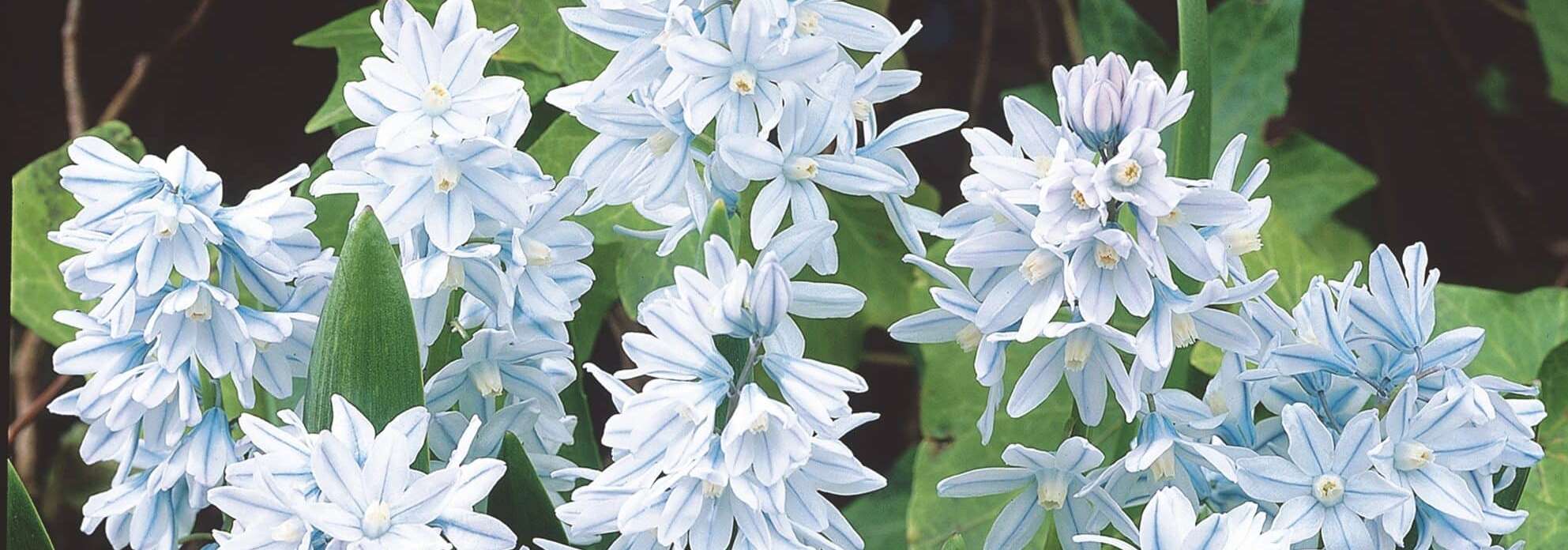
The striped squill is a little thing, and easy to walk past until you crouch down to it. Then you see the trick that names it, for every one of its small pale blue stars is drawn over with a deeper blue line down the middle of each petal, as though someone had gone round the flower with a fine pen. It opens in March, spreads itself about without any help from you, and belongs with the scillas and the glories of the snow that flower alongside it. Puschkinia is the name, and the one we offer is the old favourite, libanotica.
When does it flower
In March and on into April, among the very earliest of the spring bulbs. Each little bulb throws up a short spike of six or eight bells, the palest silver blue, opening to flattish stars, and it is the fine darker stripe down every petal that tells you it is a puschkinia and not a scilla. Stand back and the effect is a soft haze of blue barely fifteen centimetres high; kneel down and the striping is exquisite. The grassy leaves are barely there, just enough to feed the bulb and then gone.

Where should you plant it
Give it sun, or the light shade under deciduous shrubs, and almost any soil will do so long as it drains. Puschkinia is as hardy and as easy as a bulb gets. It does well in short grass, in the rock garden, and along the front of a border, and it settles into all three without a murmur. Chalk, clay and sand are all one to it. The single thing it will not stand is ground that stays wet through the winter.
How do you plant it
Plant the little bulbs in the autumn, five to eight centimetres down and about as far apart, in good handfuls rather than one by one. Then leave them completely alone. Puschkinia increases by seed and by offset into wider and wider drifts over the years, and the only attention it ever asks for is none at all. It is one of those bulbs you put in once and enjoy for a lifetime.
Why grow it
For the sheer ease of it, and for that striped detail that so few people ever stop to notice. This is a plant for naturalising in numbers, for the rock garden, for the edge of a woodland path, anywhere you want a wash of early blue that comes back stronger with every spring. It is fully hardy, untroubled by anything the weather does, and it wears the Royal Horticultural Society's Award of Garden Merit for its trouble. Grow it with the other small blues and let them all knit together.
Plant these with your puschkinia
The striped squill is made for company, and it looks its best in a drift of the other little bulbs that open with it in the earliest weeks of spring. Plant it among these three and the blues will run together across the ground.


The puschkinia our customers buy most
In stock today, at the prices in the shop. Choose how many bulbs you want.
| Bulb | Dec | Jan | Feb | Mar | Apr | May | Jun | Jul |
|---|