Spring Is in the Air. Quite Literally
Hyacinths have long been a family speciality, and I do think they are often overlooked in our British gardens. Perhaps because we have become so accustomed to seeing bowls of hyacinths we sometimes forget what a truly outstanding garden plant they are. Mention Keukenhof and most people immediately think of tulips, yet there are also swathes of hyacinths, bringing perfume as well as colour to the spring planting.

We don’t plant on that scale, but a group near the house, beside a path or in a pot by the front door will give far more pleasure than bulbs tucked away where we seldom pass. Their relatively short stems suit the front of a border, and they are particularly useful for bringing blues into the spring garden.
For most of us, our second instinct is smell, we are instinctively drawn to the scent of the flowers, not just their appearance. For many of the spring bulbs scent is vital in attracting pollinators and hyacinths are most famous for their scent. The modern garden varieties come from a single wild species, Hyacinthus orientalis. Native to the eastern Mediterranean it carries a loose spike of up to a dozen pale blue flowers. The perfume was there before gardeners began improving the display.
By incorporating scent in the garden “we can have a garden within a garden, not much less rich and various than the other which appeals to the eye”.
-
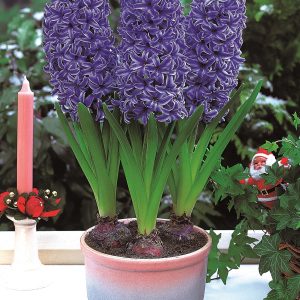 Blue Jacket GardenPrice range: £10.40 through £36.20
You save (%) -
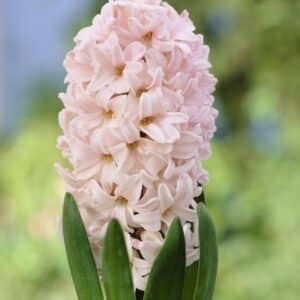 Apricot Passion GardenPrice range: £10.40 through £36.20
You save (%) -
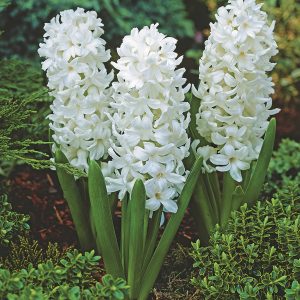 Aiolos GardenPrice range: £11.20 through £38.80
You save (%)


Planting for spring success
When planting your bulbs follow these keys to guarantee spring success.
- For planting small areas or clumps of bulbs the trowel is the ideal weapon of choice. Otherwise, use a spade. Lightly fork the soil first, this makes planting much easier.
- Avoid a cone shape at the bottom of the hole, bulbs do not like sitting in water.
- If you have heavy soil put in a small layer of grit to act as a cushion for the bulb. It is important that there are no air pockets between the base of the bulb and the soil.
- Don’t push the bulb too firmly into the soil as this can damage the root tips which lie just under the surface of the basal plate.
- Planting depths are a general guide only and can be adjusted depending on your soil, shallower for heavy soil, deeper for light sandy soils.
- Lightly rake the area after planting. Persistent heavy rain, when it eventually arrives, can leave a surface crust on bare cultivated soil, known as soil capping.