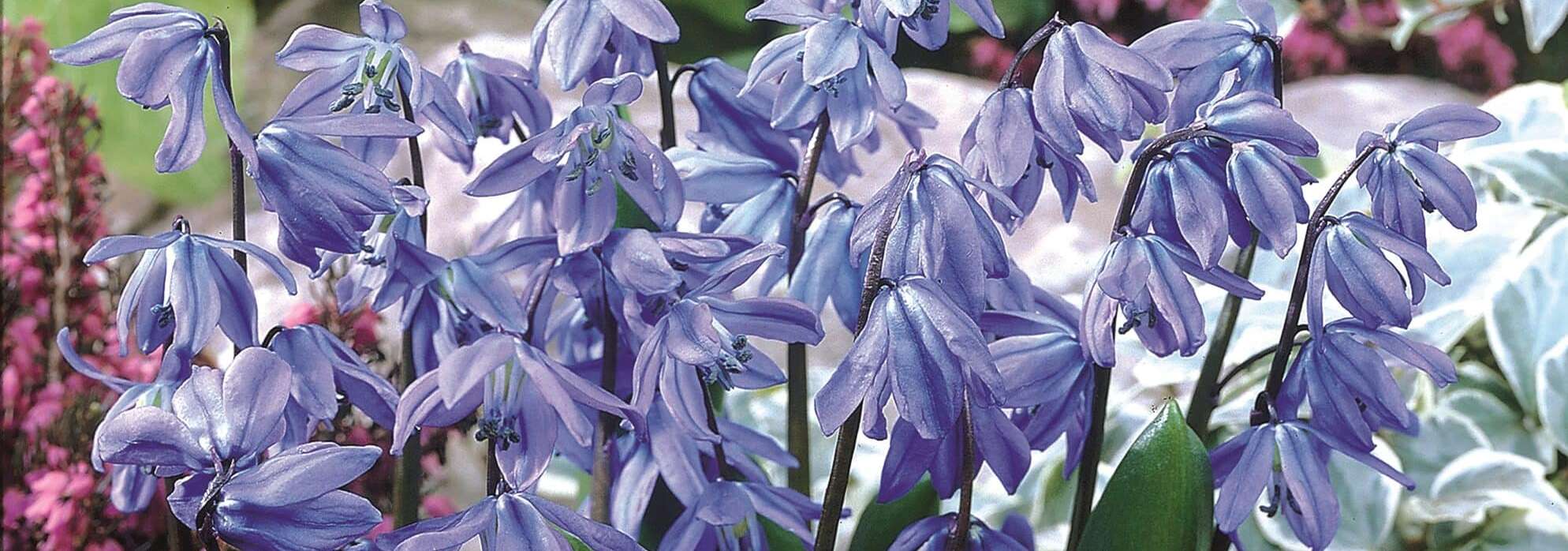
Say scilla and a gardener will most likely picture the little squills, those low sheets of intense blue that open with the snowdrops and run across the ground like spilled ink. Fair enough, for they are the ones most of us grow. But the name covers a second plant too, a tall late spike for the border that could hardly look less like its dwarf cousins. Both are easy, both are as blue as blue gets, and it is worth knowing which of the two you are buying before you plant.
The Little Early Squills
The dwarf squills flower in February and March, at the very front of the season, in nodding bells of the deepest gentian blue over low grassy tufts barely fifteen centimetres high. Siberica is the classic, a blue so pure it seems almost to glow on a grey day, and a drift of it under bare trees is one of the great sights of early spring. They multiply with a will, by seed and by offset, until a handful of bulbs has become a haze of blue that comes back thicker every year.

Where Should You Plant Them
Sun, or the dappled shade under deciduous trees and shrubs, on any ground that drains. The little squills are as tough and as willing as bulbs come, thoroughly hardy and entirely unfussy, equally at home in short grass, in a rock garden, or threaded through the front of a border. They ask for nothing and they spread of their own accord, so plant them where you are happy for them to roam and then leave them to get on with it.
Spend and Save
The more you plant, the more you save. The discount applies to your whole order, and delivery is free over £100.
How Do You Plant Them
Plant the small squills in the autumn, setting them six centimetres or so down and a similar distance apart, in bold groups rather than thin lines. The taller Blue Arrow, being a bigger bulb, goes a little deeper, nearer ten centimetres, and prefers a sunnier, sharper spot. After that they all look after themselves. The dwarves in particular seed about freely, so give them room, and lift and divide a congested clump once it has died down if you want to spread it further.
The Three Small Squills

Among the small kinds, siberica is the one to start with, that unbeatable gentian blue, and an Award of Garden Merit confirms the point. Spring Beauty is a larger, deeper, more vigorous form of it, a little later and a little bolder in every way. Earliest of the lot is Tubergeniana, properly Scilla mischtschenkoana, which opens in the last of the winter in the palest ice blue, each petal drawn with a darker line down the middle, and it is an Award winner too.
The Tall Blue Arrow
We almost hesitate to shelve Blue Arrow beside the others, so different is it. Forget the low blue carpet. This one is Scilla hyacinthoides, and it grows more like a small foxtail, one straight spike to your knee or higher, hung with more little violet stars than you could count, and it waits until May or June to do it. It is a creature of hot Mediterranean hillsides, so it wants the sunniest, sharpest corner of a border and no truck with grass or shade. Grown well it stops people in their tracks, for hardly anyone knows what it is.

Plant These With Your Scilla
The little squills belong in a drift with the other small blues of the earliest spring, all of them naturalisers that enjoy the same sun and the same free draining ground. Scatter these three among them and let the blue spread as wide as it likes.


Bloms Private Membership
Free postage for a full year. It comes free with any order over £100, or you can add it at checkout for £9.95.