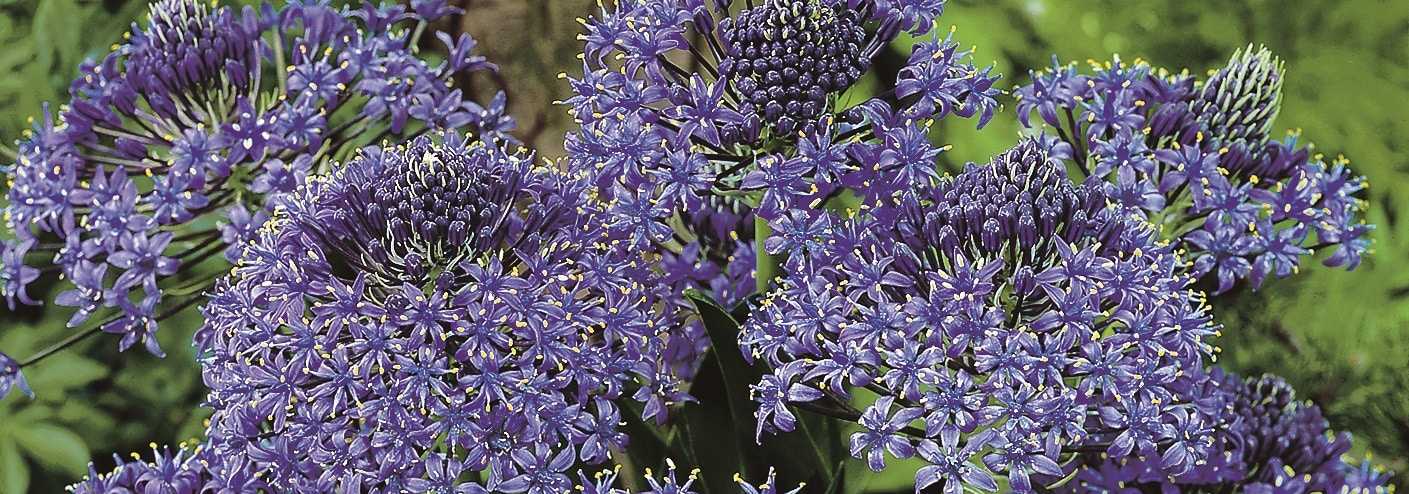
Here is a plant that lies about where it comes from. Scilla peruviana has never seen Peru; it is a child of the Mediterranean, of Spain and Portugal and the baking hills of North Africa, and the Peru of the name was, they say, only the ship that carried it. Names aside, it is a showstopper. In late spring it heaves up a great domed head of starry violet blue, fifty flowers and more crammed into a cone the size of a fist, over broad and glossy leaves. Subtle it is not. Portuguese squill and giant squill are its other names, and it earns them both.
When Does It Flower
It flowers in May and June, at the turn from spring to summer, and it does so slowly and grandly. Each stout stem carries a broad pyramid of bloom, the lowest flowers opening first and the cone building upward over two or three weeks until fifty or more little stars are out at once, a dome of the most intense blue violet. Beneath it sit broad, glossy, strap shaped leaves that are half evergreen, coming up in the autumn and lingering long after the flowers. A white form exists, but it is the blue that stops people.

Where Should You Grow It
In the hottest, sunniest, sharpest drained spot you can find, and nowhere else. This is the one thing to get right. Scilla peruviana comes from a climate of wet winters and baking summers, and in a British garden it wants full sun, very free draining ground, and the shelter of a warm wall, so that it never sits cold and wet through the winter. It is not reliably hardy in a heavy, damp soil. Many gardeners sidestep the risk altogether and grow it in a pot of gritty compost, stood out for the summer and moved somewhere dry and frost free for the winter.
Spend and Save
The more you plant, the more you save. The discount applies to your whole order, and delivery is free over £100.
How Do You Plant It
Plant it shallow, with the nose of the bulb at or just below the surface, for it likes to bake. Autumn is the usual time, or the spring from a pot already in growth. It keeps its leaves through much of the year, so handle it gently and disturb it as little as you can, and let it dry off and rest once the flowers are over and the foliage begins to tire. Grown hard and dry and sunny, it settles in and flowers the better for it every year.
Why Grow It
Because nothing else in the garden looks quite like it. A well grown head of Scilla peruviana is a genuine talking point, an exotic looking thing that turns out to be far tougher than it appears, and in a pot by a sunny door it is very hard to beat. Grow it for the drama, for the sheer depth of that blue, and for the small pleasure of telling anyone who asks that the plant from Peru is nothing of the sort.
Plant These With Your Scilla Peruviana
Scilla peruviana wants heat and sharp drainage, and it does best in a bed of things that crave the very same. The three below all bake happily in a hot, open spot through the first weeks of summer. Plant them together and let the sun do the rest.


Bloms Private Membership
Free postage for a full year. It comes free with any order over £100, or you can add it at checkout for £9.95.